Most people have never sold a junk car before. They've got a dead vehicle sitting in the driveway, they know it's worth something, and they have no idea where to start. If you're in St. John's — or anywhere across Canada — that uncertainty is normal. But the process is simpler than you think.
This guide walks you through junk car removal step by step. No guesswork. No runaround. Just a clear picture of what happens from the moment you decide to sell to the moment cash hits your hand and the tow truck drives away.
Step 1 — Figure Out What Your Junk Car Is Actually Worth
Before you call anyone, you need a baseline. Scrap car value today depends on a handful of factors: the weight of the vehicle, current scrap metal prices, the condition of key parts, and your location. A full-size pickup truck in Newfoundland and Labrador carries more scrap metal by weight than a compact hatchback — and that difference shows up in your quote.
Your first move is to gather basic information about the vehicle:
- Year, make, and model
- Approximate mileage
- Whether it runs or not
- Condition of the body (rust, accident damage, missing panels)
- Whether the catalytic converter is still intact
- Whether you have the title or registration
Use a how much is my junk car worth calculator as a starting point — most reputable buyers offer one online. It won't give you a final number, but it narrows the range. Expect a junk car in average condition to land somewhere between a few hundred and a couple thousand dollars, depending on the factors above. Platforms like smashrecycling.ca help connect sellers with competitive buyers so you're not just guessing at market value — you're letting buyers compete for your load.
Step 2 — Understand What Drives Your Scrap Car Value Today
The single biggest driver of how much is the average junk car worth is scrap metal pricing. Steel, aluminum, copper, and platinum-group metals all fluctuate week to week. When steel prices are up, your junk car is worth more. When they drop, your quote drops with them.
Here's what buyers actually look at when they inspect your vehicle:
- Ferrous metal (steel and iron): The frame, body panels, and engine block. This is the bulk of your car's scrap weight.
- Non-ferrous metals: Aluminum wheels, copper wiring, and radiators. These command higher prices per pound than steel.
- Catalytic converter: This is often the most valuable single component on a junk car. It contains platinum, palladium, and rhodium — all precious metals with real market prices. If your cat is still attached and intact, it can add significant value to your quote.
- Reusable parts: Working alternators, starters, doors, and glass can be resold before the car is crushed. Buyers who strip before scrapping may pay more for cars with usable parts.
If you've been wondering whether to sell catalytic converters online separately before calling a junk car buyer — know that some buyers price the cat into their offer. Always ask. If they're quoting you with the cat included, removing it yourself and selling it separately could void their offer or reduce the quoted pickup price. Get clarity before you touch anything.
Step 3 — Get Quotes and Compare (Don't Take the First Offer)
This is where most people leave money behind. They call one buyer, hear a number, and take it. That's the old way — one buyer, one phone call, and no idea if the price is fair.
The smarter move is to get at least two or three quotes before you commit. If you're in St. John's, you may find the local buyer pool is smaller than in Toronto or Calgary — which makes it even more important to reach beyond your immediate area. National platforms that connect you with vetted buyers give you options even when your geography limits you.
SMASH — the scrap metal auction platform — exists specifically to solve this problem. When you list a vehicle or load through SMASH, vetted buyers can submit competing offers. That competition is how price discovery actually works. More buyers seeing your listing means a better chance of a fair offer. You can get a free car valuation through cash-for-cars services that work alongside platforms like SMASH to put your vehicle in front of the right buyers.
When you're comparing quotes, pay attention to:
- Whether the quote includes free towing or charges a pickup fee
- Whether the catalytic converter is priced in or excluded
- How long the quote is valid (metal prices move, and so do offers)
- Whether they handle paperwork or leave that to you
Step 4 — Prep the Vehicle and Handle Your Paperwork
Once you've accepted an offer, there's a short checklist before pickup day. Don't skip this — it protects you legally and makes the handoff clean.
Remove your personal belongings. Check the glove box, under the seats, in the trunk, and in any door pockets. People regularly forget toll transponders, insurance documents, registration papers, and personal items they'll want back.
Remove your license plates. In most Canadian provinces, plates stay with the owner, not the vehicle. In Newfoundland and Labrador, you'll need to return your plates to Service NL or transfer them to another vehicle. Check your province's rules — the buyer won't handle this for you.
Cancel your insurance. Once the car is gone, you don't need coverage on it. Call your insurer before or on the day of pickup. Some people overpay for months on a car they no longer own.
Have your title or ownership documents ready. Most buyers require proof that you're the registered owner. If you've lost the title, contact your provincial motor vehicle authority to get a replacement before you book the pickup.
Step 5 — The Pickup Day — What to Expect
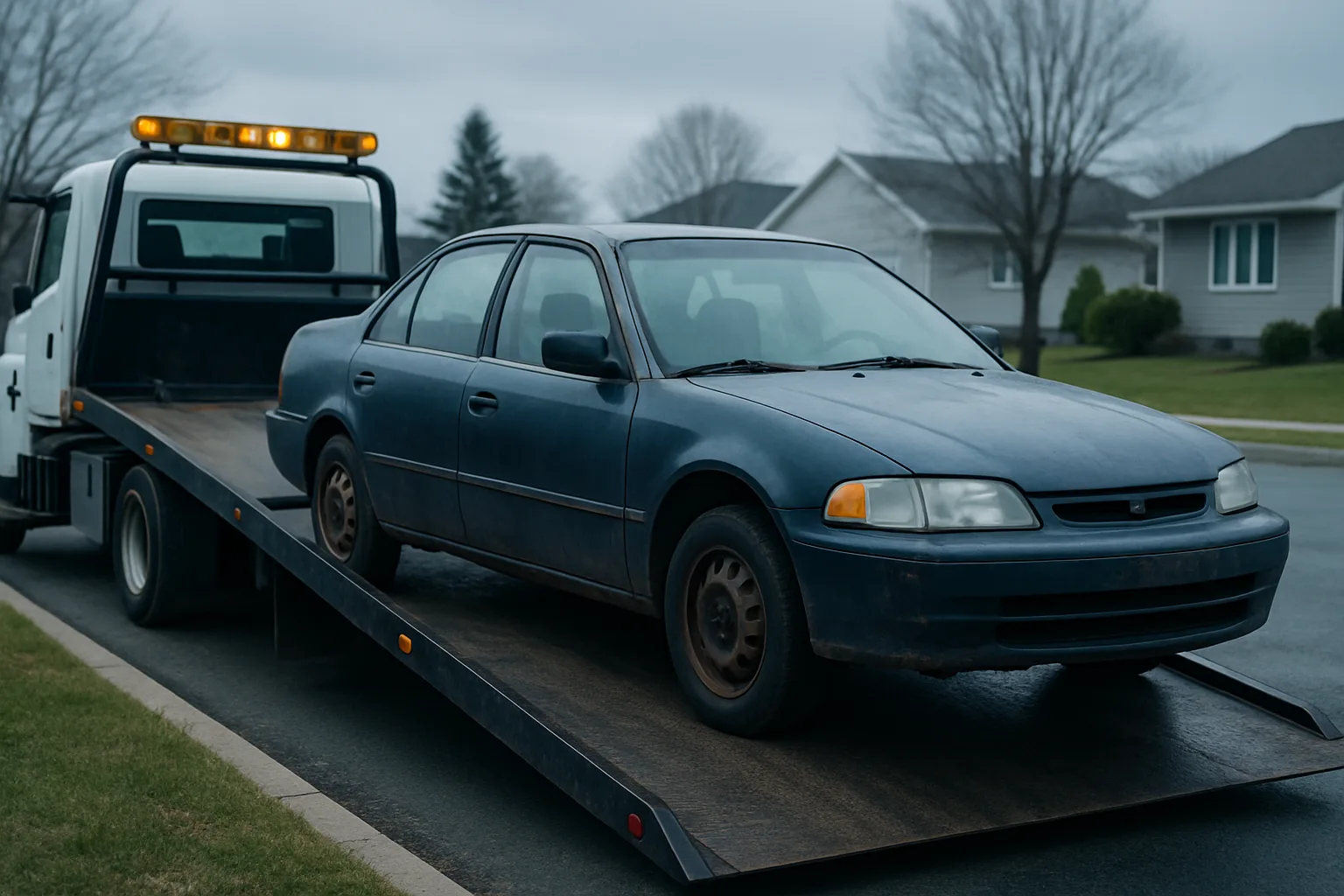
Junk car removal in St. John's works the same way it does anywhere else in the country. The buyer sends a tow truck — usually a flatbed — to your address. They verify the vehicle matches what was quoted, confirm the paperwork, and load it up. In most cases, this takes under an hour.
Payment typically happens on the spot. Cash is common for smaller loads. Some buyers use e-transfer, especially for higher-value vehicles or when the deal is arranged through a platform. Confirm the payment method before pickup day so there are no surprises.
If the buyer shows up and tries to lower the price based on condition — a practice called "rebidding" — you have the right to walk away. Legitimate buyers honor their quoted price as long as the vehicle matches the description you gave. If you were upfront about the condition, the quote should stand.
Once the car is loaded and payment is made, get a receipt. That receipt is your record of the transaction — useful if any questions come up later about the vehicle's title or disposal.
How SMASH Fits Into the Junk Car Process
Most people think of junk car removal as a purely local transaction. Call a local yard, get a price, hand over the keys. But that model limits you — especially in regions like Newfoundland and Labrador where the buyer pool may be thin.
SMASH changes that dynamic. As a SMASH scrap auction platform, it connects sellers with vetted buyers across North America. Whether you're selling one car or a whole yard's worth of end-of-life vehicles, listing through SMASH means your inventory gets seen by more buyers. More eyes means better price discovery — that's not a marketing line, it's just how competition works.
SMASH also handles the documentation side — photo documentation, inventory tools, and auto-invoicing — so the transaction is cleaner for both sides. For anyone serious about getting a fair price for a junk car or a bulk load of scrap vehicles, it's worth understanding how auction-based pricing works versus the single-buyer, take-it-or-leave-it model.
If you want to sell your car for cash across Canada, the infrastructure is there — you just need to use it. And if you want to go deeper on the selling process, read Canadian car selling guides that break down province-specific rules, metal pricing basics, and how to document your vehicle for the best possible offer.
Whether you're in St. John's, Edmonton, or anywhere in between — the process is the same. Know your car's value, get competing quotes, prep your paperwork, and hand it off cleanly. That's it.
Ready to stop looking at that dead car in your driveway? Sell your car for cash across Canada — get a free quote at cashforcars-canada.ca and find out what your vehicle is actually worth today.
Frequently Asked Questions
Q: How does junk car removal work in St. John's?
The process is straightforward. You provide details about your vehicle, receive a quote from a buyer or platform, accept the offer, and schedule a pickup. A tow truck comes to your location — whether that's a home, a driveway, or a business — loads the vehicle, and pays you on the spot. The whole process typically takes one to two business days from quote to pickup.
Q: How much is the average junk car worth in Newfoundland and Labrador?
There's no single answer — it depends on the vehicle's weight, condition, and current scrap metal prices. A typical passenger car might yield a few hundred dollars, while a heavier truck or SUV with intact components like a catalytic converter can bring significantly more. Use an online junk car calculator as a baseline, then get multiple quotes to see where the market actually lands.
Q: Do I need the title to sell my junk car in St. John's?
Most buyers require proof of ownership — typically your vehicle registration or title. If you've lost your documents, contact Service NL to request a replacement before booking a pickup. Selling without proof of ownership can create legal problems for both you and the buyer.
Q: Should I remove my catalytic converter before selling my junk car?
Not necessarily. Many buyers price the catalytic converter into their offer — it's one of the most valuable parts on a junk car. Before you remove anything, ask the buyer whether the cat is included in the quote. Removing it without telling them could change the offer or create disputes on pickup day.
Q: Can I sell my junk car for cash if it doesn't run?
Yes. Non-running vehicles are bought and sold every day across Canada. Buyers account for the tow cost and condition in their offer, but a car that doesn't start is still worth something as scrap metal. Be upfront about the condition when you request a quote so the price you're given reflects reality.
Follow SMASH on LinkedIn for scrap metal market updates, industry insights, and tips on getting more from your loads.
```