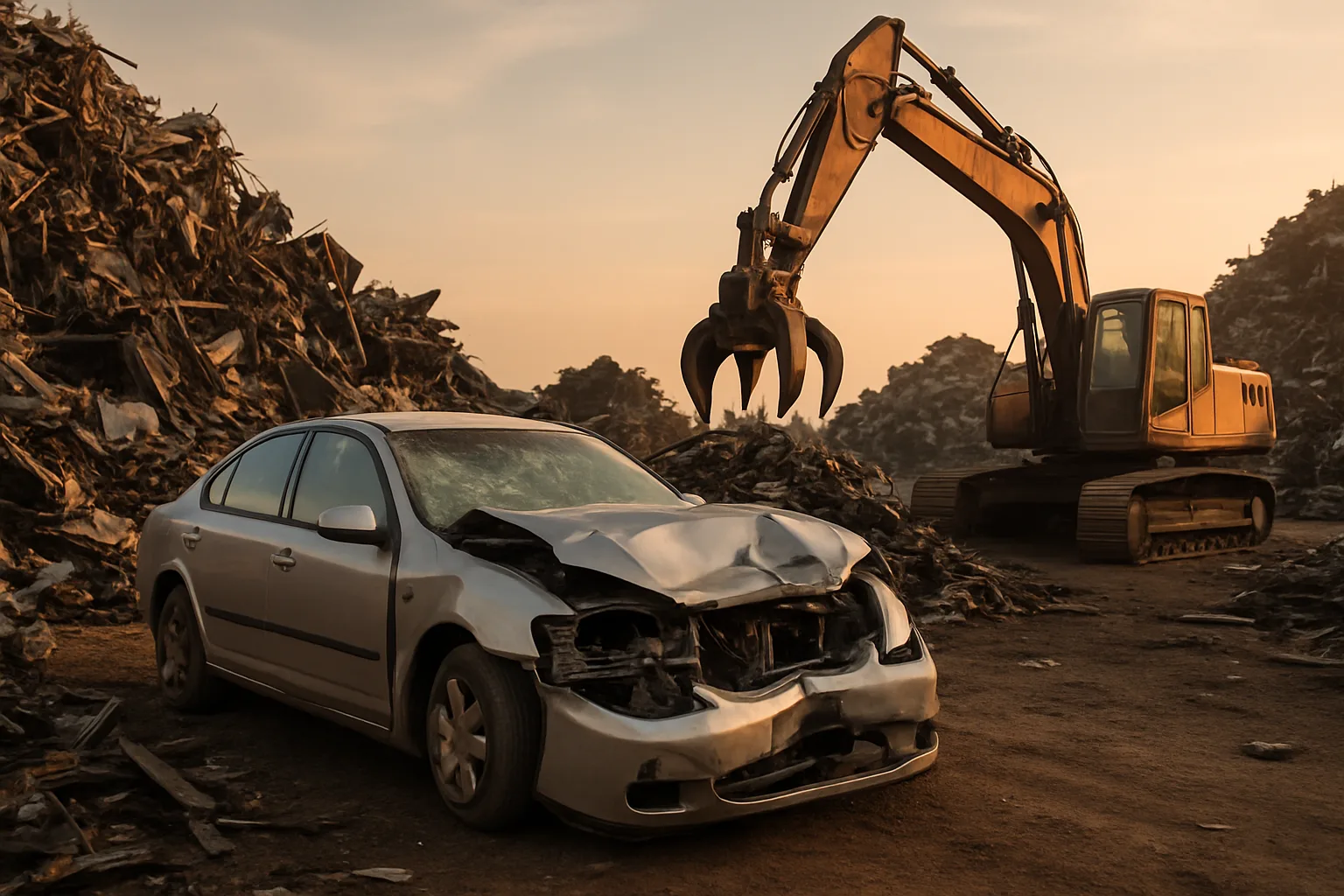
Your car got wrecked. Now what? Whether it was a fender-bender that totalled the insurance value or a serious collision that left the frame twisted, accident-damaged vehicles sit in more Canadian driveways than most people realize — costing storage space, stressing owners out, and losing value every week they sit idle.
If you're trying to sell my junk car Barrie after an accident, you're not alone. And the good news? A wrecked car is still worth real money. You just need to know how to approach it the right way.
This guide walks you through everything — from assessing what your accident-damaged car is actually worth, to pulling the most value from its parts, to getting paid fast without the runaround.
Why Accident-Damaged Cars Still Have Real Scrap Value
A collision doesn't destroy a car's worth. It changes it. The retail value disappears fast after a serious accident — but the scrap and parts value holds. Steel is steel. A catalytic converter doesn't care that the bumper is crushed. Copper wiring, aluminum rims, and a working engine block all retain market value regardless of what the exterior looks like.
In Canada, scrap car values are driven largely by the weight of the vehicle and the commodity price of the metals inside it. A mid-size sedan typically weighs between 1,300 and 1,600 kilograms. Even at conservative scrap metal rates, that's a meaningful payout — especially when you factor in valuable components like the catalytic converter, which can be worth significantly more than the bulk steel weight alone.
Here's what holds value on an accident-damaged vehicle:
- Catalytic converter — contains platinum, palladium, and rhodium; often the single most valuable scrap component
- Engine and transmission — if undamaged by the accident, these are in demand as used parts
- Aluminum wheels — non-ferrous metal, priced separately from bulk steel
- Battery — lead-acid batteries have consistent scrap value
- Copper wiring harness — copper is one of the most valuable non-ferrous metals by weight
- Radiator and AC condenser — often aluminum/copper mix, sorted separately at the yard
The key insight: don't let anyone tell you a wrecked car is worthless. The question is whether you're getting the full picture of what it's worth — or just accepting the first number someone throws at you.
How to Assess Your Car's Value After an Accident
Before you call anyone, do a quick inventory. You don't need to be a mechanic — you just need to answer a few basic questions that every buyer will ask anyway.
- What's the make, model, year, and trim? Platforms like SMASH use VIN lookup to pull accurate vehicle specs. Have your VIN ready — it's on the dashboard near the windshield or on your ownership documents.
- What's the approximate weight? Check your owner's manual or look up the curb weight online. This directly affects your scrap car value per ton calculation.
- Where is the damage? Front-end, rear-end, rollover, and flood damage all have different implications for parts salvage. A front-end collision that missed the engine bay is very different from one that destroyed it.
- Does it run or drive? Non-running vehicles are still fully buyable — but it affects logistics. Most reputable buyers across Ontario will tow for free regardless.
- Do you have the title/ownership? In Ontario, you need to transfer ownership when you sell. Missing paperwork slows everything down.
Once you have these answers, you're in a much stronger position when you get a free car valuation — and you're less likely to accept a lowball offer because you didn't know what you had.
The Catalytic Converter Question — and Why It Matters for Accident Cars
If your accident-damaged vehicle still has its catalytic converter intact, pay close attention to this section. The "cat" — as it's known in the scrap industry — is often the most valuable single component on any vehicle heading to scrap. Precious metals inside it (platinum, palladium, rhodium) fluctuate with commodity markets, but the values can be substantial relative to the bulk steel value of the entire car.
The problem? Most car owners have no idea what their catalytic converter is worth, and some buyers count on that ignorance. The gap between what a cat sells for at a catalytic converter auction versus what a buyer tells a seller it's worth can be significant. Transparency matters here.
This is exactly where platforms like Canada's B2B scrap recycling marketplace SMASH create a real advantage. SMASH uses serial tracking and photo documentation for catalytic converters, bringing them to competitive auction among vetted buyers. That competition is what drives price discovery — instead of one buyer telling you what your cat is worth, multiple buyers bid for it. More buyers means better price discovery. It's that straightforward.
If you're selling an accident car in Barrie or anywhere in Ontario, ask specifically about how the catalytic converter is being valued. Don't let it get bundled into a lump-sum offer with no breakdown.
How to Sell My Junk Car in Barrie — Step by Step
The process doesn't have to be complicated. Here's the practical sequence for anyone in Barrie or across Ontario looking to sell a scrap car in Ontario after an accident.
- Gather your documents. Ontario requires a signed Vehicle Permit (ownership) to transfer title. If you've lost it, you can get a replacement through ServiceOntario. Don't skip this — no legitimate buyer will complete a purchase without it.
- Remove your personal belongings. Sounds obvious, but accident cars often have items scattered through the interior. Check the trunk, under seats, and the glovebox before the tow truck arrives.
- Cancel your insurance and plates. In Ontario, you return your plates to the Ministry — they don't stay with the car. Cancel insurance once the sale is complete. Doing it before the sale could create a gap that complicates the transaction.
- Get multiple quotes. The single biggest mistake sellers make is calling one buyer and accepting the first offer. Accident cars especially benefit from competitive quoting — different buyers have different needs for parts versus bulk scrap.
- Confirm towing is included. Most reputable junk car buyers across Canada include free towing. If someone is deducting a tow fee from your offer, factor that into your comparison.
- Get paid before the car leaves. Cash, e-transfer, or certified payment — whatever the method, confirm payment before you hand over the keys and sign the transfer.
For Barrie residents specifically, local Barrie scrap metal services can handle pickup directly in the area — no need to arrange transport to the GTA or elsewhere in Ontario.
Common Mistakes That Cost Sellers Money on Accident Cars
Most sellers don't lose money because the market is bad. They lose it because of avoidable mistakes in the selling process. Here are the ones that come up most often.
Accepting a single phone quote without documentation. Verbal quotes change. Get the offer in writing — even an email — with a breakdown of how the number was calculated. A legitimate buyer won't have a problem with this.
Not separating high-value components. If you have time and access, a mechanic or auto recycler can remove the catalytic converter, battery, or aluminum wheels before you sell the bulk. You may net more selling those separately, depending on your situation. That said, most sellers value simplicity — which is completely valid. Just know the trade-off.
Selling to an unvetted buyer. In Ontario and across Canada, there are buyers who operate informally, sometimes without proper licensing. This creates liability issues for the seller if the car is used in a way that comes back to you. Stick to buyers who complete the ownership transfer properly.
Ignoring the weight. Scrap car value per ton is the baseline metric. If a buyer won't tell you what rate they're paying per ton for the steel, that's a red flag. The math should be transparent.
To avoid all of this, use platforms and services designed around transparency and competition. SMASH, for example, provides documented inventory, vetted buyers, and auction-format pricing that removes the guesswork on both sides of the transaction.
What to Expect When You Sell Your Car for Cash — Timelines and Payouts
If you're trying to sell my car fast Barrie after an accident, here's the realistic timeline. Most legitimate cash-for-cars buyers can complete pickup within 24 to 72 hours of quote acceptance. Some offer same-day service in high-density areas.
Payment is typically made at the point of pickup. E-transfer is the most common method in Canada right now — fast, traceable, and doesn't require handling physical cash. Some buyers still offer cash; confirm your preference upfront.
As for payout amounts: they vary based on vehicle weight, the condition of high-value components like the catalytic converter, current metal commodity prices, and local demand for parts. Anyone who gives you a firm number without knowing your vehicle details is guessing. A proper sell car for scrap quote requires at minimum the year, make, model, and a description of the damage.
If you want to sell your car for cash across Canada without the back-and-forth, the process is simple: provide your details, get a documented quote, schedule pickup, and get paid. That's how it should work.
For ongoing insights into what's driving scrap metal values across Canada — including catalytic converter pricing trends and commodity market updates — read Canadian car selling guides to stay informed before your next sale.
Whether your car is sitting in Barrie, across Ontario, or anywhere else in Canada, you deserve a fair, documented offer — not a guessing game. Start with a free quote at cashforcars-canada.ca and see what your accident vehicle is actually worth today.
Frequently Asked Questions
Q: Can I sell my junk car in Barrie if it has accident damage and doesn't run?
Yes. Non-running accident vehicles are bought regularly across Barrie and Ontario. Most reputable buyers include free towing as part of the offer. The car's value is based on its weight and components — not whether it drives.
Q: Do I need to have the title to sell a scrap car in Ontario?
Yes. Ontario requires a signed Vehicle Permit (ownership) to legally transfer the vehicle. If you've lost yours, replacements are available through ServiceOntario. Selling without proper documentation creates liability risks for you as the seller.
Q: How is the catalytic converter value factored into my scrap car quote?
It should be assessed separately from the bulk steel weight. The catalytic converter contains precious metals that are priced independently. Ask your buyer for a breakdown — if they won't provide one, that's worth questioning. Platforms like SMASH use competitive auction formats for catalytic converters specifically to ensure transparent pricing.
Q: How fast can I sell my car for cash in Barrie after an accident?
Most buyers can schedule pickup within 24 to 72 hours of a confirmed quote. Same-day service is sometimes available. Have your ownership documents ready and confirm your preferred payment method ahead of time to avoid delays.
Q: What's the difference between scrapping an accident car and selling it privately?
A private sale requires the car to be roadworthy or at least presentable to buyers — accident-damaged vehicles rarely meet that bar without costly repairs. Scrapping bypasses all of that. You get paid based on metal and parts value, not retail condition. For most accident vehicles, scrapping nets more money with far less hassle than attempting a private sale.
``` --- *Stay current on scrap metal market trends and catalytic converter pricing — follow SMASH on LinkedIn at [linkedin.com/company/scrap-metal-auction-sales-hub](https://www.linkedin.com/company/scrap-metal-auction-sales-hub) for weekly industry insights across Canada.*