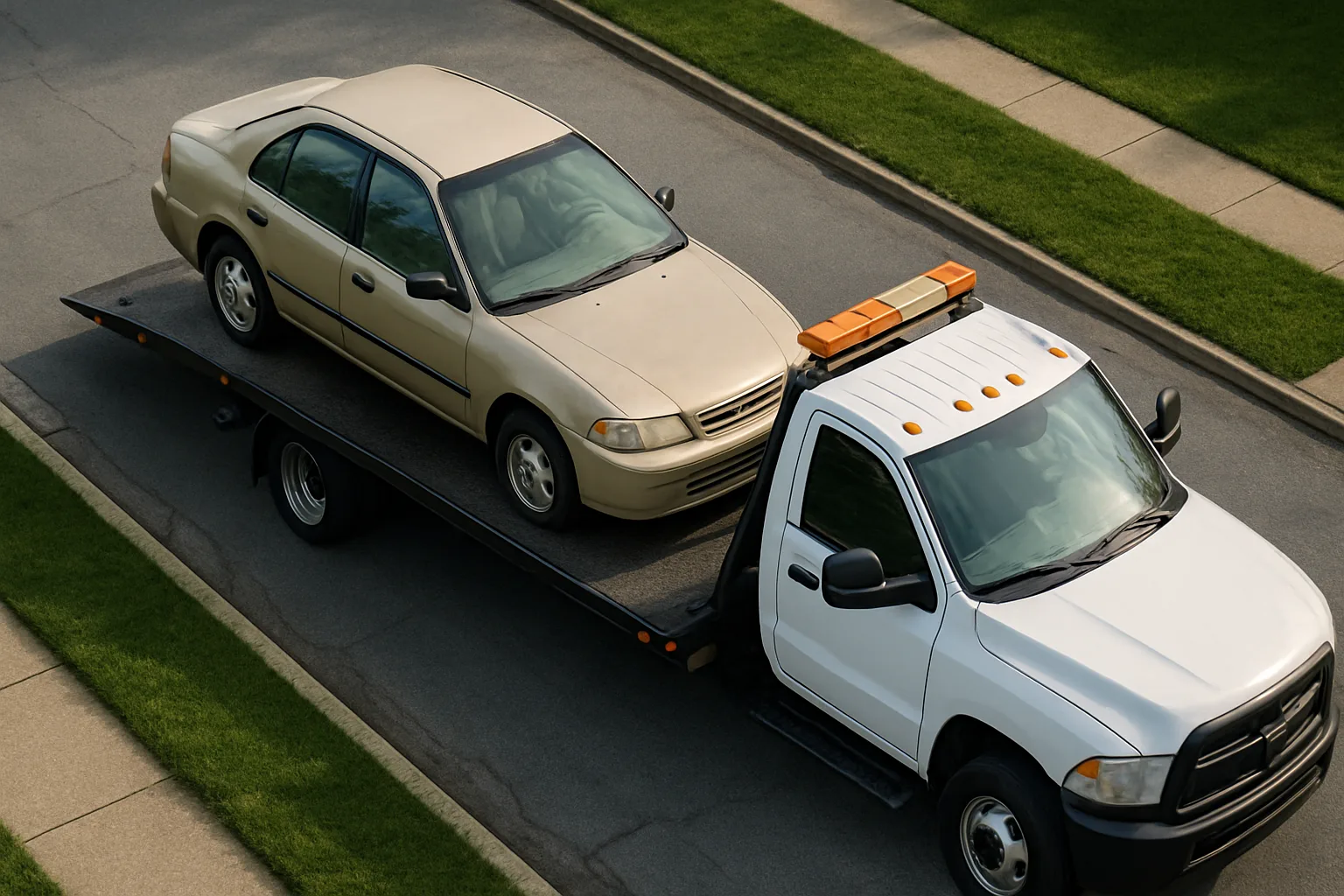
You've Been Lied To About Junk Car Removal (Here's the Truth)
Most car owners in Halifax leave hundreds of dollars on the table — not because their car isn't worth anything, but because they believe things about junk car removal that simply aren't true. Myths about titles, pickup fees, and what "scrap" actually means cost people real money every year. If you're sitting on a dead, damaged, or unwanted vehicle and haven't called anyone yet, there's a good chance one of these myths is the reason why.
Let's kill them one by one — with straight answers and no fluff.
Myth #1: You Need a Clean Title to Sell a Scrap Car in Nova Scotia
This is the big one. A huge number of car owners across Nova Scotia — and across Canada — assume that if they've lost the title, or never had one in their name, the car is unsellable. That's not accurate. Many legitimate junk car buyers will work with you using other documentation: your government-issued ID, the vehicle's VIN, registration history, or a statutory declaration.
The rules vary by province, but in Nova Scotia, a scrap yard or licensed buyer can often process a vehicle without the original title in hand. If you've been searching for cash for cars no title near me and hitting dead ends, the issue usually isn't the law — it's who you're calling. Work with a buyer who knows provincial regulations and has handled no-title situations before. They exist. Don't let a missing piece of paper stop you from getting paid.
- Lost your title? Check with Service Nova Scotia about replacement documentation options.
- Inherited a vehicle? A death certificate and proof of relation may be enough to proceed.
- Car was never transferred into your name? A licensed buyer can often still help — ask upfront.
Myth #2: Free Scrap Car Pickup Halifax Doesn't Actually Exist
People see "free pickup" advertised and immediately assume there's a catch — a low-ball offer, hidden fees on the backend, or a bait-and-switch once the tow truck arrives. Sometimes that suspicion is warranted. But free scrap car pickup in Halifax is a real, standard service offered by reputable buyers. The tow is factored into the offer you receive upfront. No surprise deductions when the driver shows up.
The catch — if you can call it that — is that not every buyer offering free pickup is giving you a fair price. That's the real risk. A tow costs them maybe $150 to $200. If they're offering you $300 for a car worth $600 at scrap weight, they're making their margin on your ignorance, not on the tow. This is exactly why competition matters. When multiple buyers are bidding on your vehicle, the tow cost gets absorbed into a genuinely competitive offer rather than used as leverage against you.
Platforms like SMASH Recycling — where verified buyers bid on your metal exist precisely for this reason. Instead of calling one yard and hoping they're honest, you get vetted buyers competing for your load. That changes the dynamic entirely.
Myth #3: A Junk Car Is Worth the Same Everywhere — Just Take the First Offer
This myth costs Nova Scotia car owners more money than almost any other. The assumption is that scrap is scrap — iron is iron, and whatever the first buyer quotes is what the car is worth. That's not how it works.
A vehicle isn't just bulk steel. It contains non-ferrous metals, fluids, usable parts, rubber, and — critically — a catalytic converter. That cat alone can be worth anywhere from a modest amount on a base model to significantly more on certain trucks, SUVs, and hybrids, depending on platinum group metal (PGM) content. If you're selling a 2015 F-150 or a Toyota Sienna, your catalytic converter matters. A yard that gives you a flat "junk car" quote without accounting for the cat is either keeping that value for themselves or hasn't properly assessed your vehicle.
The catalytic converter auction model — where converters are individually assessed and put to market — is increasingly how serious recyclers maximize recovery value. SMASH Recycling — where verified buyers bid on your metal connects sellers with buyers who know exactly what they're bidding on. That transparency is what proper price discovery looks like.
Whether you're in Halifax, trying to sell car for scrap in Sydney, or anywhere else in Nova Scotia, the principle holds: one quote is not a market. Get more than one.
Myth #4: Your Car Has to Run to Be Worth Anything
This one stops people cold — sometimes literally. The car died in the driveway two years ago. It hasn't started since. They assume it's worthless, or at best worth a token amount just to get it towed away. Wrong.
A non-running vehicle still has weight. Steel, aluminum, copper wiring, the catalytic converter, the battery — none of that disappears because the engine seized. In many cases, a non-running car is worth the same at scrap as a running one of the same make, model, and year. The only thing a running vehicle adds is the ability to drive it to the yard yourself, which saves the tow cost. That's it.
If your car is sitting dead in Halifax and you've written it off, don't. It has mass, and mass has value. Get a proper quote based on the vehicle's actual weight and metal content — not on whether it turns over.
- Non-running cars are accepted by virtually every licensed scrap buyer in Canada.
- Free tow is standard — the car's condition doesn't change that.
- Missing parts (hood, doors, seats) do affect value. Be upfront about condition upfront.
- A seized engine doesn't reduce the steel content of the frame by a single kilogram.
Myth #5: SMASH Scrap and Online Platforms Are Only for Big Operators — Not Individual Car Sellers
There's a perception that auction-style platforms and digital scrap marketplaces are built for recycling yards moving 40-foot containers of shredded metal — not for someone trying to sell their car for cash across Canada. That perception is outdated.
The reality is that individual vehicle sellers benefit from competitive buyer networks just as much as commercial operators do — arguably more, because they're less likely to have established relationships with multiple buyers. When a recycling yard calls their regular buyer, they've got history. They know the range. When you call a single yard as a private seller, you're going in blind.
SMASH brings structure to that process. Vetted buyers. Documented inventory. Transparent bidding. No subscription fees on the seller side — SMASH only wins when the seller wins. If you've been hesitant because you thought platforms like this were built for industry insiders only, that's the myth talking. Read Canadian car selling guides to understand how the market actually works before you accept a quote from a single buyer.
Myth #6: Cash for Cars Buyers Are All the Same — Just Pick the Closest One
Location matters for logistics. It doesn't determine the quality of the offer or the professionalism of the buyer. Choosing the closest junk car buyer in Halifax without comparing offers is like accepting the first price you see on a used car listing — you might get lucky, but you're not making an informed decision.
What actually separates a good buyer from a bad one:
- Transparency on pricing methodology — do they explain how they calculated your offer, or just throw a number at you?
- Clarity on what's included — is towing actually free, or does it come off the top of your payment?
- Proper licensing — are they a licensed vehicle recycler in Nova Scotia? Ask.
- Documentation — do they provide a proper bill of sale and receipt? You need that for deregistration.
- Payment method — cash or certified cheque on pickup is standard. Don't accept e-transfers that require "processing time" from unknown buyers.
The best way to ensure you're dealing with a legitimate, competitive buyer is to use a service built around verified buyers and documented transactions. That's what get a free car valuation through a platform connected to vetted buyers actually looks like in practice — not a random Google result and a hope for the best.
If you're in Cape Breton trying to sell car for scrap in Sydney, or searching for sell scrap car Halifax options from Dartmouth, the geography is secondary. Buyer quality and competitive offers are what move the needle on what you walk away with.
Frequently Asked Questions
Q: Can I sell a scrap car in Halifax without a title?
Yes, in many cases you can. Nova Scotia buyers and licensed recyclers often accept alternative documentation — government ID, the vehicle's VIN, registration records, or a statutory declaration. The process depends on your specific situation, so be upfront with the buyer about what you have. A reputable buyer will tell you exactly what's required rather than turning you away at the door.
Q: Is free scrap car pickup in Halifax actually free, or are there hidden fees?
With reputable buyers, free pickup means the tow cost is included in your quoted price — you don't pay anything out of pocket and nothing is deducted from your payment at the time of pickup. Always confirm this in writing or verbally before the truck arrives. If a buyer quotes you $400 and then subtracts $150 for towing when they show up, that's not free pickup — that's a bait-and-switch.
Q: How long does the junk car removal process take in Nova Scotia?
Most car sellers in Nova Scotia complete the process within 24 to 72 hours of accepting an offer. Same-day pickup is available in Halifax and surrounding areas depending on the buyer's schedule. Once you accept an offer, the buyer typically arranges towing, completes paperwork on-site, and pays you at pickup. The whole process is faster than most people expect.
Q: Does my car need to run to get cash for cars in Halifax?
No. Non-running vehicles are accepted by virtually every licensed scrap car buyer in Canada. The vehicle's value is based on its weight, metal content, and parts — not whether the engine starts. Free towing is standard, so a dead vehicle in your driveway is just as retrievable as a running one.
Q: What affects how much I get when I sell a scrap car in Nova Scotia?
The main factors are the vehicle's weight (heavier vehicles contain more steel), the condition and presence of the catalytic converter, current scrap metal prices, and whether valuable parts are still intact. A 2014 pickup truck will fetch more than a 2003 compact sedan — not because of brand preference, but because of raw material content. Getting multiple offers, rather than accepting the first quote, is the single most effective way to improve your payout.
If you've been putting off dealing with that dead or unwanted vehicle because one of these myths had you convinced it wasn't worth the effort — now you know better. Halifax has active buyers, free pickup is real, and your car has value regardless of whether it runs or has a clean title. You can also explore Halifax scrap metal services to find local options that match your situation.
When you're ready to stop guessing and start getting real offers, sell your car for cash across Canada through a process built on competition and transparency — not a single cold call to a single buyer who sets the price alone. Get a fair market read on what your vehicle is actually worth at cashforcars-canada.ca.
Follow SMASH on LinkedIn for scrap metal market insights, industry updates, and tips that help you make smarter decisions — whether you're selling one car or managing a yard full of them.