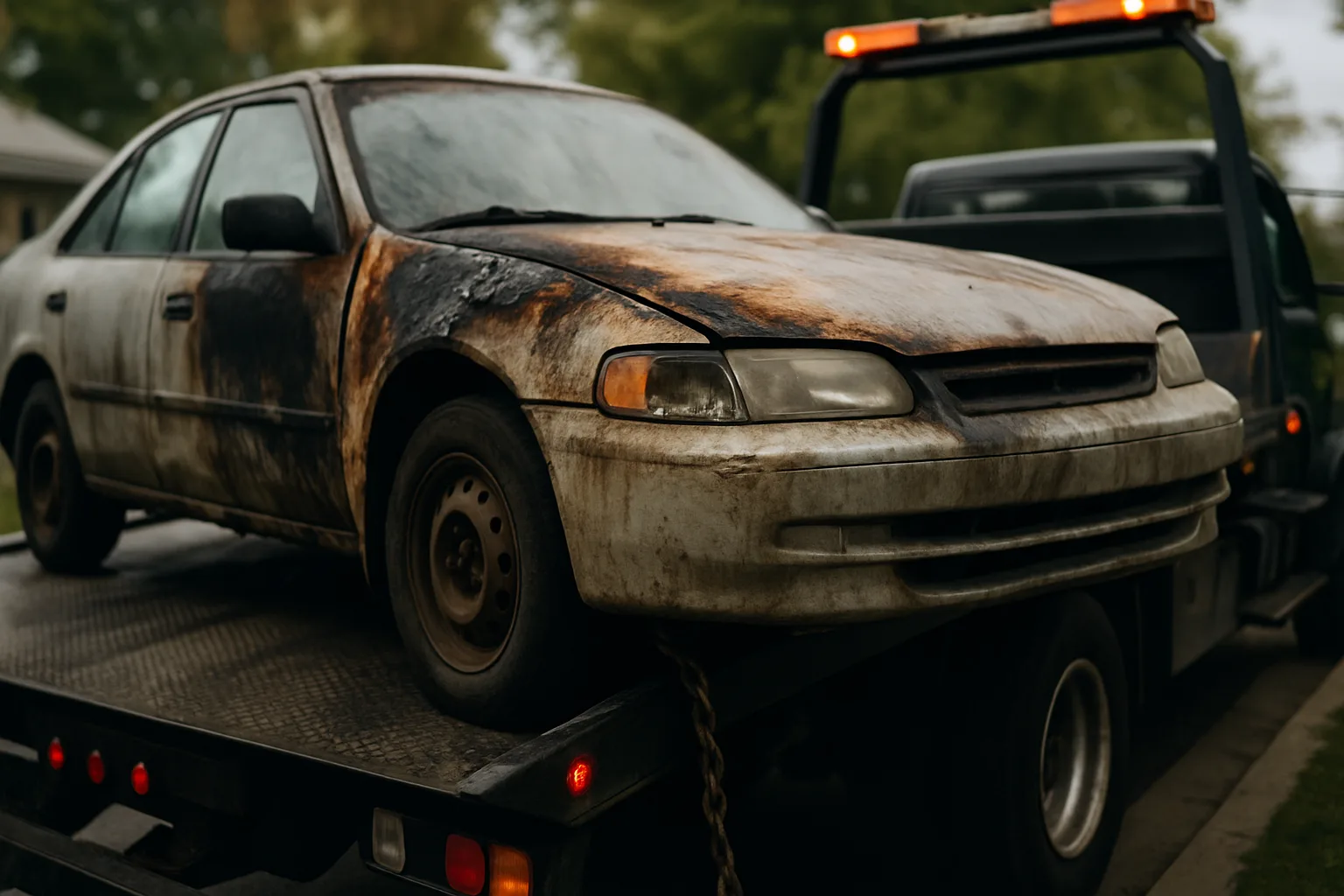
What Flood and Fire Actually Do to Your Car's Value (And What You Can Still Recover)
A flooded or fire-damaged vehicle sitting in your driveway isn't just an eyesore — it's a depreciating asset losing value every week it stays there. Most Canadian car owners in this situation assume they're stuck with nothing. That's not accurate. Even a severely damaged vehicle has recoverable value, and knowing how to extract it is the difference between walking away with cash and paying someone to haul it away.
Whether your car took on water during a flash flood in Laval or caught fire on the highway, this guide walks you through exactly what your vehicle is worth, what buyers actually want, and how to turn a wrecked car into cash — fast.
Understanding What Flood and Fire Damage Actually Destroys
Before you can price your vehicle, you need to understand what these two damage types do differently. Flood damage and fire damage aren't the same problem — and buyers price them differently.
Flood-damaged vehicles typically suffer from:
- Electrical system corrosion — the most expensive repair on any modern vehicle
- Engine and transmission contamination from water intrusion
- Mould growth inside the cabin, which makes the vehicle undriveable for anyone with respiratory issues
- Airbag system failures triggered by water in the sensor modules
- Frame rust that accelerates significantly after extended water exposure
Fire-damaged vehicles present a different set of issues:
- Structural steel warping from extreme heat — even vehicles that look intact externally may have compromised frames
- Complete destruction of wiring harnesses, which are expensive to replace in newer vehicles
- Engine block cracking or total seizure depending on where the fire originated
- Glass, plastic, and interior components that are almost never salvageable
- Potential hazardous material issues if the battery or fuel system was involved
Here's what matters for your cash recovery: even a vehicle that's been gutted by fire or saturated by floodwater still contains steel, aluminum, copper wiring, and — critically — a catalytic converter. These components have real market value independent of whether the car ever runs again. If you want to understand your scrap car value today, you need to think about your vehicle as a collection of parts and metals, not a broken machine.
How Junk Car Removal Works for Damaged Vehicles in Laval
The process for selling a flood or fire-damaged vehicle is more straightforward than most people expect. You don't need the car to run. You don't need to fix anything. You don't even need to clean it out. What you do need is a clear sense of what the vehicle contains and what documentation you have.
Here's how the process typically works when you pursue junk car removal in Laval:
- Get a valuation. Describe the vehicle accurately — year, make, model, damage type, and whether the catalytic converter and major components are still present. Honest descriptions get you better offers and avoid disputes at pickup.
- Receive competing offers. This is where most car owners leave money on the table. Calling a single buyer and accepting their first number is the old way. Platforms that bring multiple vetted buyers to the table — like SMASH Recycling — where verified buyers bid on your metal — create actual competition around your vehicle's salvage value.
- Arrange pickup. Most buyers in the Quebec market handle towing. You should not be paying out of pocket for this on a vehicle sale. If someone's quoting you a "towing deduction," that's worth pushing back on.
- Transfer the title. In Quebec, you'll need to handle the vehicle registration transfer properly. Keep copies of everything. A clean title transfer protects you from liability if the vehicle is later misused.
- Get paid. Cash or e-transfer are both standard. Don't release the vehicle until payment is confirmed.
The entire process — from first contact to vehicle pickup — often takes 24 to 72 hours for standard junk car sales in the greater Montreal and Laval area. Fire and flood vehicles don't typically add delay. Buyers in this market deal with damaged inventory routinely.
The Catalytic Converter Question: Don't Leave It Behind
This is the part most car owners in Quebec don't think about until it's too late. Your catalytic converter — even on a burned or flooded vehicle — may still contain recoverable platinum group metals (PGMs). These include platinum, palladium, and rhodium, all of which have commodity market value that fluctuates daily.
If your vehicle's catalytic converter survived the flood or fire (fire is more likely to damage it than water), that single component can meaningfully affect your total payout. Buyers who know how to sell catalytic converters online through proper channels are getting accurate, competitive pricing based on actual assay values — not guesswork.
When you're evaluating buyers for your flood or fire vehicle, ask specifically what they're offering for the catalytic converter. A buyer who quotes a single number for the whole vehicle without breaking out the cat may be bundling that value in a way that doesn't reflect actual market rates. If the buyer uses a platform like SMASH that tracks serial numbers and provides documented valuations, you're in a much stronger position. Platforms like these exist precisely to bring transparency to a market that's traditionally been opaque.
You can also get a free car valuation before you talk to any buyer. Knowing what your vehicle is actually worth — including the catalytic converter — before you start negotiating changes the conversation entirely.
What Affects Your Scrap Car Value Today After Major Damage
Not every flood or fire-damaged vehicle is priced the same. Several variables significantly affect what you'll walk away with. If you're trying to understand your scrap car value near me, these are the factors that move the number:
Vehicle weight and metal composition. Heavier vehicles — trucks, SUVs, full-size vans — contain more steel and aluminum. More metal means more value at the scrap yard, regardless of how badly the vehicle was damaged. A full-size pickup that flooded is worth more in scrap than a subcompact that flooded, period.
Completeness of the vehicle. Has anyone already stripped the catalytic converter, copper wiring, or aluminum wheels? Stripped vehicles are priced lower — sometimes significantly lower. If your car is sitting outside in Laval and has been there for months, this is worth checking before you call buyers.
Current metal market conditions. Steel, aluminum, and PGM prices change with global commodity markets. What a buyer offered in January may be different from what they offer in July. Always get a current quote rather than relying on what a neighbour got six months ago.
Extent of damage. A vehicle that flooded but was recovered quickly with minimal mould and no fire is worth more than one that sat submerged for days. Fire damage that was limited to the engine bay leaves more recoverable value than a vehicle that burned from the inside out.
Completeness of documentation. Having your registration, proof of ownership, and a clear account of the damage history makes the transaction faster and sometimes more valuable. Buyers move with more confidence when the paperwork is clean.
If you're navigating the Quebec market and want to understand your options across the province, read Canadian car selling guides that break down province-specific considerations, timelines, and what to expect from buyers in different regions.
Why Competitive Pricing Matters More Than You Think
The scrap and salvage vehicle market in Quebec — and across Canada — has historically been a one-buyer, one-phone-call transaction. You call a local yard, they give you a number, you either take it or you don't. Most people take it because they don't know what else to do.
That model is broken. And it consistently undervalues damaged vehicles because sellers have no way to pressure-test the offer they receive.
The better approach is to get competing offers. When multiple vetted buyers see your vehicle — its weight, damage type, component inventory, and location — and bid against each other, you get actual price discovery instead of a single opinion. That's the foundation of what SMASH scrap is built on. Real competition. Transparent documentation. No guessing.
For cash for cars Quebec sellers specifically, this matters because the provincial market has its own pricing dynamics around towing distances, buyer density, and local metal demand. A buyer in Montreal prices differently than one in Sherbrooke. Getting multiple bids surfaces that variation instead of hiding it behind one number.
You can sell your car for cash across Canada through services that understand this — and that work with buyers who compete for your vehicle rather than just showing up with a lowball offer and a tow truck.
Frequently Asked Questions
Q: Can I sell a flood-damaged car in Laval if I still owe money on it?
Yes, but the process is more involved. You'll need to work with your lender to discharge the lien before or at the point of sale. Some buyers in the Quebec market are experienced with this and can help coordinate the payoff. Be upfront about any outstanding financing when you request your quote — it affects the transaction logistics, not necessarily the vehicle's value.
Q: Does fire damage disqualify my car from junk car removal in Laval?
Not at all. Fire-damaged vehicles are a routine part of the salvage market. Even a vehicle that burned significantly still contains recoverable metal — steel, aluminum, and often a partially intact catalytic converter. The value depends on what's left, but fire damage alone doesn't disqualify a vehicle from sale.
Q: How do I know if my scrap car value today is accurate?
The best way is to get multiple offers and compare them. Metal commodity prices change daily, and a single buyer's quote reflects their margin assumptions as much as actual market rates. Platforms that bring multiple buyers into a competitive bid process give you a much more reliable sense of what your vehicle is actually worth on the current market.
Q: Do I need a working engine to sell my flood or fire-damaged vehicle?
No. Junk car buyers are purchasing the vehicle for its salvage and scrap value, not its drivability. Whether the engine runs, seized, or is missing entirely affects the offer — but it doesn't prevent a sale. Be accurate when describing the vehicle's condition so the buyer's offer reflects reality.
Q: Is junk car removal in Laval and greater Quebec typically free?
In most cases, yes. Reputable buyers in the Quebec market include towing in the transaction. If a buyer quotes you a number and then deducts a towing fee before paying, that's worth negotiating or walking away from. The vehicle's value should cover the cost of pickup — you shouldn't be paying to sell something.
A flood or fire doesn't have to be the end of the story for your vehicle. There's real value in that car, and getting it means knowing what you have, finding buyers who compete for it, and not settling for the first number someone throws at you. If you're ready to move forward, get a free quote at cashforcars-canada.ca — and find out what your damaged vehicle is actually worth today.
Stay current on scrap metal market conditions and industry updates — follow SMASH on LinkedIn for insights that help you sell smarter.